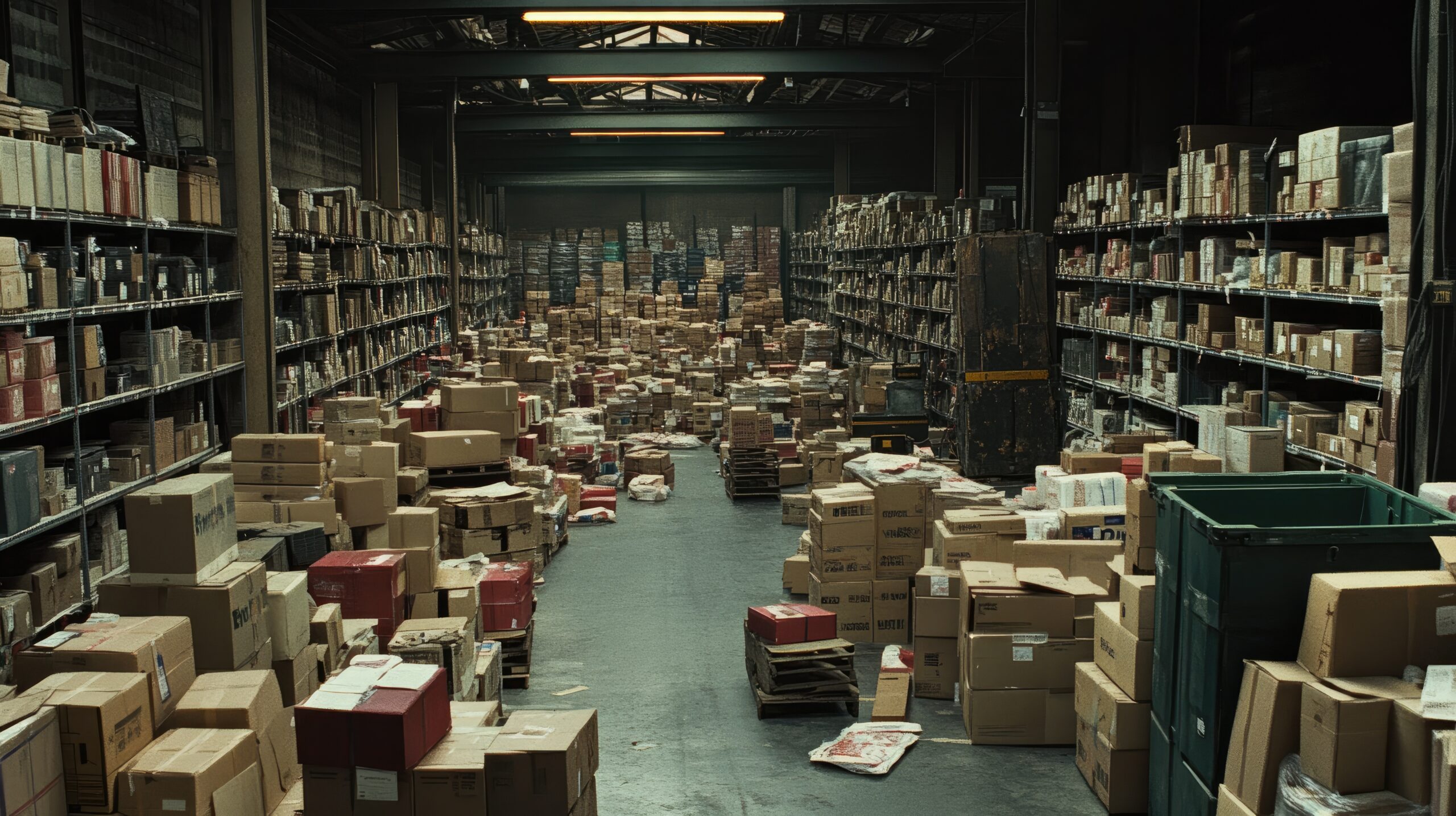
The signs are often there before a business fully recognizes them. Inventory seems harder to track, warehouse space feels increasingly crowded, orders require more manual coordination, and customers begin asking questions the team cannot answer immediately. These challenges are not always signs of poor management. Often, they indicate the business has outgrown in-house fulfillment and its current logistics model, and no amount of extra effort from the existing team fully closes that gap.
How an Early-Stage System Turns Into a Bottleneck
For companies serving the housing, construction, manufacturing, and building-supply industries, growth creates operational complexity quickly. A business may begin with a small warehouse, a few trusted suppliers, and an informal process for tracking products. Inventory may be stored across multiple areas, spreadsheets may be updated manually, and employees may rely on phone calls or emails to confirm whether a product is available. In the early days, this works because everyone involved knows the inventory well enough to catch mistakes before they matter.
These methods can work fine in the early stages of a business. The problem is that they become increasingly risky as order volume increases. A missed spreadsheet update can lead to an inaccurate inventory count. An incorrect quantity can delay a customer’s project. A miscommunication between a supplier, a warehouse, and a customer can create additional costs that ripple through the rest of the supply chain. None of these are one-time failures, they’re the predictable result of a system that was never designed to handle the volume now running through it. As order volume climbs, the same informal process that once worked fine starts generating errors faster than any one employee can catch and correct them.
Common Signs a Business Has Outgrown In-House Fulfillment
A handful of operational symptoms tend to show up together once a business has outpaced its current system:
- Frequent inventory discrepancies
- Increasing order delays or shipping errors
- Limited warehouse capacity or poorly used space
- Difficulty locating products quickly
- Excessive dependence on spreadsheets and manual processes
- Customers requesting updates that are difficult to provide
- Multiple suppliers operating without a centralized view
- Rising labor, storage, and transportation costs
- Difficulty forecasting demand or planning replenishment
- Employees spending too much time searching for information
Any one of these on its own might just be a bad week. Several of them showing up at once, and staying, is a sign the underlying system rather than the team is the actual problem. It’s worth noting that these signs rarely arrive all at once. They tend to accumulate quietly, one workaround at a time, until a business looks up and realizes the process it’s running on no longer resembles the simple system it started with.

Why This Tends to Happen Gradually, Not All at Once
Growth rarely announces itself as a single, obvious moment where a business outgrows its systems. It’s more common for a company to add a new product line, take on a larger customer, or open a second warehouse location, each individually manageable, until the combined weight of those additions starts breaking down a process built for a smaller operation. A spreadsheet that tracked fifty SKUs reasonably well starts to strain at five hundred. A warehouse team that could locate any product by memory when the space held a few thousand square feet starts losing time once it triples in size.
This gradual pattern is exactly why the signs above are worth checking against on a regular basis rather than waiting for a single dramatic failure. By the time a missed shipment or a major inventory discrepancy becomes impossible to ignore, the underlying system has usually been struggling for months.
Why These Signs Reach Beyond the Warehouse
These challenges affect more than warehouse operations. They influence customer satisfaction, cash flow, purchasing decisions, production schedules, and a company’s overall ability to compete. A customer who can’t get a fast, accurate answer about product availability starts looking elsewhere. A purchasing team reordering based on guesswork rather than real inventory data ties up cash in excess stock or, just as often, runs short at the worst possible moment. A production schedule built on inaccurate material availability creates delays that cascade into every project relying on that timeline.
At this point, the fix isn’t simply more space or more staff. Businesses need visibility into what’s actually happening across inventory, orders, and suppliers, along with a logistics partner that understands how to help them grow without losing the personal service that built their success in the first place.
Cosic LLC works with growing companies across the housing, construction, and building-supply industries to identify exactly where a current fulfillment model has stopped keeping pace, and to build a path forward that fits the business rather than forcing it into a generic template.
 Call:
 Email: