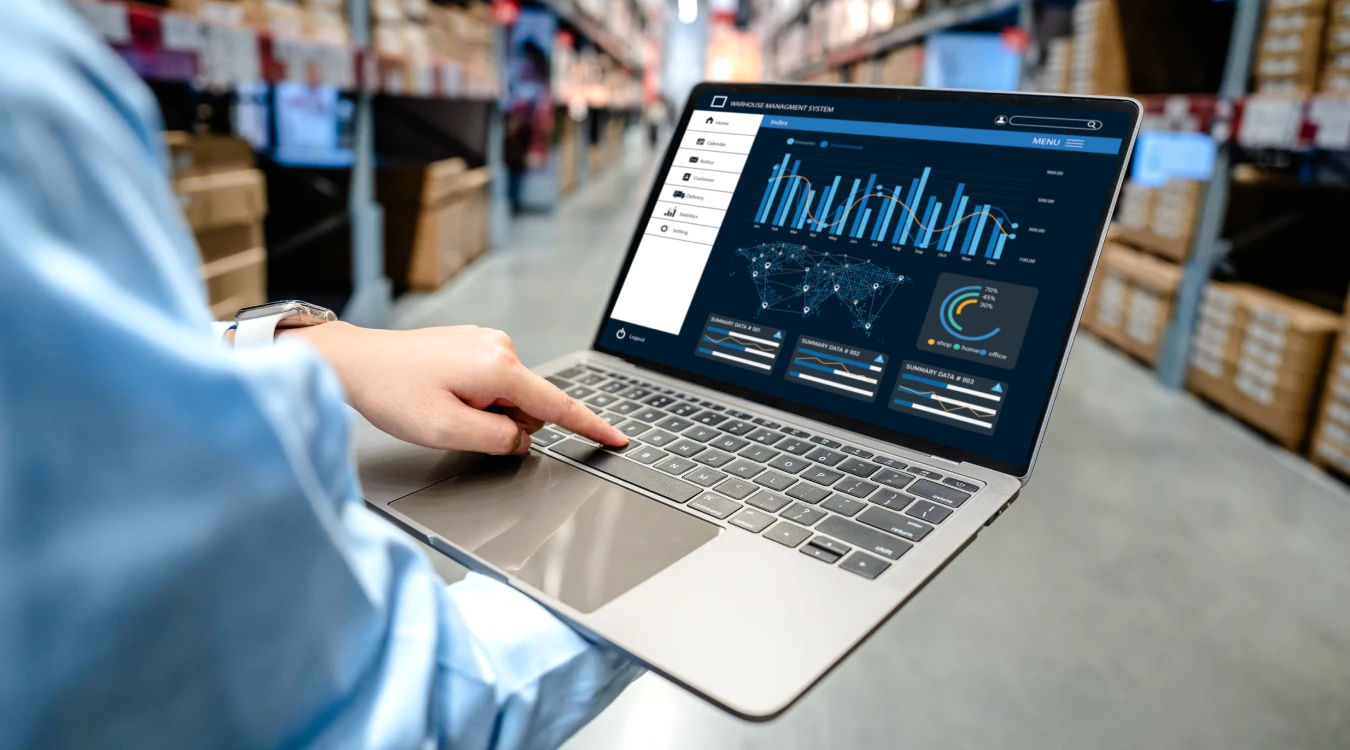
A warehouse management system, commonly referred to as a WMS, provides a structured way to manage inventory, receiving, storage, picking, packing, and shipping. Real-time WMS inventory visibility takes that capability further by providing current information about what is available, where it is located, what has been allocated, and what is moving through the supply chain at any given moment. That combination, a structured system paired with live data, is what separates a business that can answer a stock question instantly from one that has to go check.
What Makes Real-Time WMS Inventory Visibility Different
A standard WMS organizes fulfillment data. Real-time visibility makes that data current the instant something changes, rather than accurate only as of the last manual update. That distinction matters more than it sounds. A spreadsheet updated once a day is a snapshot of yesterday’s warehouse, not today’s. A system that reflects inventory the moment a product is received, allocated, or shipped means the answer to “is this in stock” is the same answer whether it’s asked at 9am or 4pm.
For businesses in housing, construction, and logistics, that difference can be the gap between responding confidently and reacting after a problem has already occurred. When a customer asks whether a product is available, the answer shouldn’t depend on someone manually checking a spreadsheet or walking through the warehouse to look. A modern WMS with real-time visibility provides direct access to inventory levels, product locations, incoming shipments, outgoing orders, and fulfillment status without that extra step. The value isn’t just speed, it’s that everyone working from the same live data reaches the same answer, whether that’s a warehouse associate, a customer service rep, or a purchasing manager.
Why Batch Updates Fall Short as Volume Grows
Many businesses start with periodic inventory updates because the volume is low enough that daily or even weekly reconciliation catches most discrepancies before they cause real problems. As order volume increases, the gap between an update and the next one becomes a wider window for something to go wrong. A product allocated to one order in the morning might get sold again to a different customer in the afternoon if the system tracking availability hasn’t caught up yet. Multiply that across dozens or hundreds of SKUs moving daily, and a batch-updated system starts producing exactly the kind of inventory discrepancies and shipping errors that signal a business has outgrown its fulfillment model, eroding customer trust along the way.
Where Real-Time Visibility Actually Improves Decisions
This kind of visibility supports better decision-making across nearly every part of a fulfillment operation, not just the warehouse floor:
- Customer service. Teams can provide faster and more accurate updates instead of putting a customer on hold to go check.
- Purchasing. Businesses can reorder based on actual current demand and inventory levels rather than a rough estimate.
- Labor planning. Managers can allocate employees more effectively during busy periods by seeing volume trends as they build.
- Space utilization. Warehouse space can be organized according to actual product movement and operational needs rather than habit.
- Order accuracy. Digital processes reduce picking, packing, and shipping errors that come from relying on memory or outdated printouts.
- Forecasting. Historical data helps identify demand patterns and seasonal changes well before they become a scramble.
- Supplier coordination. Businesses gain a clearer sense of when materials are actually expected to arrive, rather than a general estimate.
- Cash flow management. Companies can reduce unnecessary purchases and avoid excess inventory sitting on the books.
The Accountability Real-Time Data Creates
Real-time visibility also creates accountability throughout the fulfillment process. Each stage of an order, from receiving through shipping, can be tracked, measured, and improved individually. That means a business can identify exactly where a bottleneck is occurring rather than relying on assumptions about which part of the process is actually slow. A delay that looks like a shipping problem might actually be a receiving problem three steps earlier, and without real-time tracking at each stage, that distinction is easy to miss.
Cosic LLC helps businesses across the West Valley and beyond put this kind of visibility to work, connecting inventory data to the day-to-day decisions that actually determine whether a growing operation runs smoothly or starts to strain under its own volume. Visibility is one piece of a larger picture, and it typically works best as part of a broader set of supply chain solutions built for industrial suppliers.
 Call:
 Email: